Estimated reading time: 8 minutes
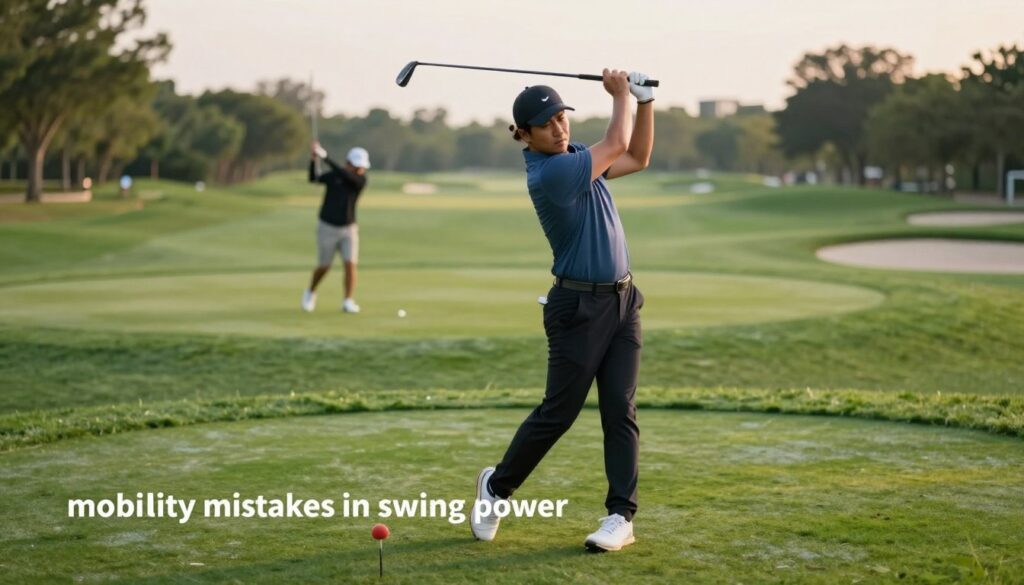
Most golfers who lack power in their swing assume it’s a technique problem.
They adjust their grip, change their stance, or spend hours on the range. But if the body itself can’t move the way the swing demands, no amount of repetition is going to solve it.
The mobility mistakes costing you power aren’t always obvious. Some feel completely normal until you understand what efficient rotational movement actually looks like.
Why Your Swing Is Leaking Power Before You Even Start
The golf swing is a rotational chain. It starts from the ground, moves through the hips, transfers through the thoracic spine, and finally reaches the arms and club. When any link in that chain is restricted, the body compensates — and compensation is where power disappears and injury begins.
Here’s the core issue most golfers miss: mobility and stability are not the same thing. You need both, in the right places, doing the right jobs.
The thoracic spine (mid-back) is built for rotation. It should be doing the heavy lifting in your backswing. The lumbar spine (low back) is built for stability. It is not designed to rotate significantly, and when it’s forced to — because the thoracic spine isn’t moving well — you end up with lower back pain, inconsistent contact, and a swing that feels like it’s always fighting you.
This is why common mobility routines fail rotational athletes: they stretch everything rather than training the body to rotate in the right segments, with control.
The 3 Mobility Mistakes Costing You Swing Power
Mistake 1: Ignoring Thoracic Spine Mobility
The thoracic spine is the engine of rotational sport. When it’s stiff, the lumbar spine picks up the slack — rotating when it shouldn’t, compressing when it can’t afford to. The result is a shortened backswing, a loss of separation between upper and lower body, and a swing that generates force from the arms instead of the torso.
A full, powerful backswing requires the thoracic spine to rotate and extend. Without that range, you physically cannot coil properly — and no amount of shoulder turn or arm movement compensates for it.
The fix isn’t just stretching it. You need to train thoracic rotation with load and control, so your body can actually use that range of motion when the swing demands it.
Mistake 2: Confusing Hip Flexibility with Hip Control
Hip mobility is essential for a fluid downswing and a stable follow-through. But most golfers work on hip flexibility without ever training hip stability — and that creates its own problems.
If your hips can move through a large range of motion but can’t control that movement under load, you’ll see compensations like over-rotating the pelvis, shifting weight onto the wrong side, or buckling at the knee during the downswing. These aren’t technique problems. They’re control problems.
What you actually need is the ability to dissociate hip movement from lumbar movement — to rotate the femur in the hip socket without cranking the pelvis or collapsing the low back. That’s a motor control skill, not just a flexibility outcome.
Mistake 3: Skipping Assessment and Just “Doing Exercises”
Pulling random mobility exercises from online and adding them to your warm-up is not the same as addressing your actual restrictions. If you don’t know where your movement is breaking down — whether it’s thoracic extension, hip internal rotation, or the connection between them — you’re guessing.
The body is highly adaptive. If a joint is restricted, a neighboring joint will compensate. That compensation can look like mobility from the outside while masking the real problem underneath. Without screening for those patterns, you can spend months on exercises that aren’t targeting the right area.
What Efficient Rotational Movement Actually Looks Like
| Area | Role in the Swing | Common Problem | What’s Actually Needed |
|---|---|---|---|
| Thoracic spine | Rotation and extension through backswing | Stiffness forces lumbar compensation | Rotational mobility + controlled extension |
| Hips | Power generation, weight transfer | Flexibility without stability = inconsistent swing | Hip dissociation + load-bearing control |
| Lumbar spine | Stability and force transfer | Over-rotation trying to compensate above/below | Stability training, not more rotation |
| Deep core | Maintains spinal position under load | Disengaged = power leaks and injury | Pilates-based activation and integration |
How to Actually Build Rotational Mobility That Transfers
The difference between a mobility routine that works and one that doesn’t comes down to whether you’re training isolated range of motion or integrated movement patterns.
Step 1: Open Book Rotations
- Target: Thoracic rotation and ribcage mobility
- Equipment: None (mat or firm surface)
- Instructions:
- Lie on your side with hips and knees stacked at 90 degrees, arms extended in front of you at shoulder height.
- Keep the bottom knee grounded. Slowly rotate your top arm open toward the floor behind you, letting your chest follow.
- Allow your gaze to follow your hand. Don’t force the shoulder to the floor — let the thoracic spine do the work.
- Return slowly. 8–10 reps per side.
- Keep the low back out of it. If you feel rotation happening at the waist, reduce your range and focus on initiating from the ribs.
Step 2: 90/90 Hip Rotations with Stability Hold
- Target: Hip internal and external rotation with pelvis control
- Equipment: None
- Instructions:
- Sit on the floor with both legs bent at 90 degrees — one in front, one to the side.
- Without using your hands, rotate to bring the rear leg forward, switching sides smoothly.
- As you rotate, keep your spine tall. The movement should come from the hips, not the lumbar spine.
- For the stability component: pause at each transition for 3 seconds before switching. This trains control, not just range.
- 6–8 full rotations.
Step 3: Segmental Rotation with Core Anchor
- Target: Thoracic rotation with lumbar stability under load
- Equipment: None (can add a light resistance band)
- Instructions:
- Stand or kneel in a tall, neutral spine position.
- Place both hands behind your head, elbows wide.
- Engage through the deep core — think of drawing the low belly gently in.
- Rotate your ribcage to one side while keeping the pelvis completely still.
- Return to center. Rotate the other direction.
- The goal is dissociation: thorax moves, pelvis doesn’t. 8–10 reps per side.
Building It Into Your Routine
The most effective approach is short, consistent work — not long sessions done sporadically.
Five to ten minutes before you play is enough to prime the system. Daily practice between rounds is where the actual change happens. The exercises above target the specific movement demands of rotational sport, so they’re not just general mobility work — they’re building the exact patterns your swing relies on.
If you’re dealing with low back discomfort during or after play, that’s usually a sign the thoracic spine or hips are restricted and the lumbar is compensating. Addressing those restrictions directly tends to resolve both the movement issue and the pain — not because you stretched your back, but because you took the load off it.
The goal isn’t just a more powerful swing today. It’s being able to rotate with the same quality and control for the next several decades.
Frequently Asked Questions
In most cases, it’s a compensation issue rather than a back problem. When the thoracic spine lacks rotation or the hips lack control, the lumbar spine picks up the rotational demand — which it isn’t designed for. Repeated stress in that pattern leads to pain over time. Addressing thoracic mobility and hip stability takes that load off the lumbar spine and resolves the root cause.
Flexibility refers to passive range of motion — how far you can stretch a muscle. Mobility includes control through that range, which is what actually matters for rotational sport. A golfer can have excellent hip flexibility and still lack the neuromuscular control to use that range efficiently in a swing. Training hip dissociation and load-bearing stability bridges that gap.
Short daily sessions are more effective than longer occasional ones. Five to ten minutes before a round is a minimum; a focused 10–15 minute practice on non-playing days is where lasting change happens. Consistency matters more than volume.
Stretching increases passive range of motion but doesn’t train the body to use that range under the load and speed of a swing. Rotational sport requires mobility with stability — the ability to move through range while maintaining core control and joint integrity. Without the stability component, new range of motion tends not to transfer to movement patterns.
The kinematic sequence is the order in which body segments generate and transfer energy during the swing: lower body initiates, then the thorax, then the arms, then the club. When any segment is restricted or firing out of order, power leaks and the risk of injury increases. Mobility training that addresses each segment in relation to the others — rather than in isolation — keeps that sequence intact.
Download the Active Body Blueprint to identify exactly where your movement is breaking down — and get a step-by-step plan to address it.