You didn’t stop being active and you didn’t skip your warm-up. You didn’t do anything dramatically wrong — and yet, your hip hurts. Maybe it’s a dull ache after a run or maybe it clicks when you step off a curb. Maybe you feel it every time you sit too long and then try to stand.
Here’s what most people do next: they rest, maybe stretch, maybe Google “hip stretches for runners” and try a few things that don’t stick. The pain returns. Or it never fully goes away.
The problem isn’t that you’re not trying. It’s that the approach most people take — passive stretching, rest, and hoping it resolves — doesn’t address what’s actually driving the pain.
Hip pain in active adults is rarely a structural problem. It’s almost always a movement problem. Specifically: a combination of poor hip mobility, missing stability, and movement patterns that load the joint the wrong way.
This guide breaks down exactly what’s happening and gives you a clear, movement-first framework for getting out of pain and staying out.
Why Active Adults Get Hip Pain (and Why Rest Makes It Worse)
This might seem counterintuitive: the people most likely to experience hip pain aren’t sedentary. They’re runners, cyclists, yoga practitioners, weekend pickleball players, and people who train consistently. Why?
Because high activity volume without movement quality creates load that the hip joint can’t distribute properly. Over time, that leads to irritation in the surrounding tissues — tendons, bursae, labrum — even when the joint itself is structurally intact.
The most common sources of hip pain in active adults include:
- Hip flexor tightness and anterior hip impingement — common in runners and cyclists who spend time in hip flexion without balancing with extension and rotation
- Greater trochanteric pain (lateral hip) — often mistaken for IT band issues, frequently driven by gluteal tendinopathy or weak lateral hip stabilizers
- Labral stress — when the hip lacks full range of motion, the labrum absorbs load it wasn’t designed for
- SI joint and low back referral — hip mobility restriction often shows up as low back pain because the lumbar spine compensates
Why does rest make it worse? Because the tissues that support the hip — tendons, ligaments, and the joint capsule — are load-dependent. They adapt to loading. When you remove load entirely, they lose capacity. Pain returns the moment you return to activity, and you’re back to square one.
The goal isn’t to stop moving. It’s to move better.
The Hip Mobility–Stability Connection Most People Miss
Most hip pain protocols focus on one thing: stretching. Stretch the hip flexors. Open the hip with a figure-four. Foam roll the IT band. These tools aren’t wrong — they just don’t fix the underlying issue, which is that the hip lacks stability through its available range of motion.
Here’s the distinction that changes everything:
Mobility is your ability to move a joint through its range of motion. Stability is your ability to control that joint under load. You need both.
When stability is missing, the nervous system restricts range of motion as a protective mechanism. That’s often what you’re experiencing as “tight hips” — not shortened muscle fibers, but a neurological lock designed to keep you from moving into a range the system doesn’t trust.
This is why passive stretching gives temporary relief but doesn’t create lasting change. You need to train the hip to be stable in its full range — not just to get there passively.
The Pilates approach to hip health is built on this principle. Rather than isolating the hip flexor and pulling on it, we train the hip in integrated patterns that develop strength, coordination, and motor control simultaneously. The result isn’t just less pain — it’s a hip that performs better under any load.
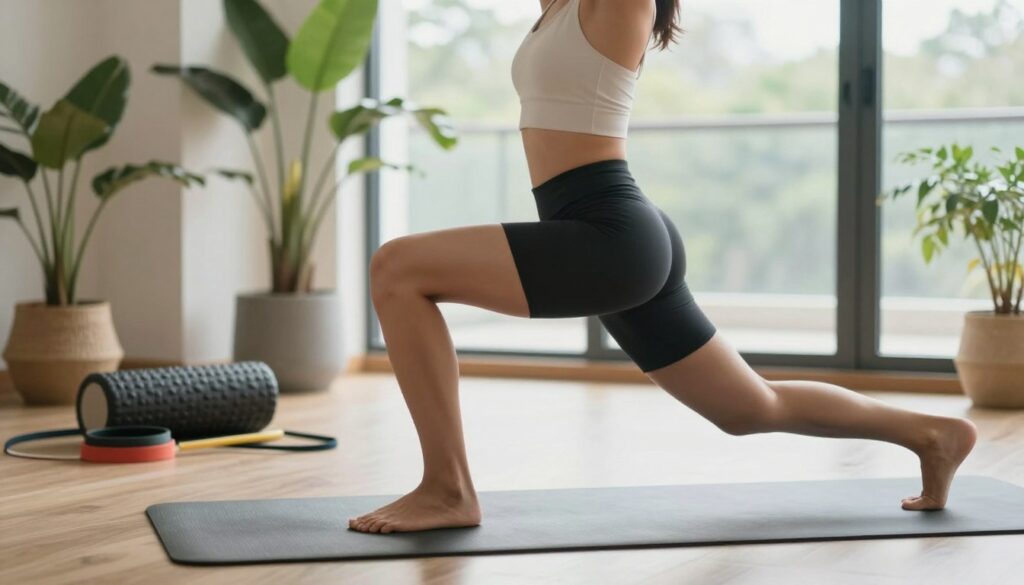
5 Movement Patterns That Cause Hip Pain in Runners and Rotational Athletes
Knowing what’s driving your pain is the first step to fixing it. These are the five most common movement dysfunctions that load the hip incorrectly and lead to chronic pain in active adults.
1. Anterior Pelvic Tilt Under Load
Running, squatting, or hinging with the pelvis tipped forward compresses the anterior hip capsule and hip flexor attachments. Over distance or volume, this creates a cumulative irritation that shows up as pain in the front of the hip or groin. The fix is not stretching the hip flexors harder — it’s training the posterior chain and deep abdominals to hold neutral pelvis under load.
2. Hip Drop During Single-Leg Loading
When the pelvis drops on the non-stance side during running or single-leg exercises (Trendelenburg sign), the stance-side hip is absorbing load it shouldn’t. This stresses the lateral hip structures — particularly the gluteal tendons — and is one of the primary drivers of greater trochanteric pain syndrome. Strengthening the hip abductors in loaded, single-leg positions addresses this directly.
3. Reduced Hip Extension at Toe-Off
Many runners and cyclists lack terminal hip extension — the ability to fully drive the hip back at the end of the gait cycle. When this is missing, the lumbar spine extends instead, compressing the low back and creating a hip flexor that never fully lengthens. Over time, this limits performance and creates anterior hip pain.
4. Absent Hip Internal Rotation
Internal rotation is one of the most commonly restricted hip movements — and one of the most important for rotational athletes. Golfers, tennis players, and pickleball players who lack internal rotation on the trail leg compensate through the low back, SI joint, or knee. Restoring and loading internal rotation is a high-priority fix for this population.
5. Overreliance on the Hip Flexor Complex for Core Stability
When the deep abdominals and pelvic floor aren’t doing their stabilization job, the psoas compensates by staying chronically braced. This creates the sensation of tight hip flexors that don’t respond to stretching — because the tightness is neurological, not mechanical. The intervention is deep core training that teaches the nervous system it doesn’t need the psoas to hold everything together.
Hip Pain Relief Exercises: A Pilates-Informed Approach
The following exercises address the hip mobility–stability relationship across multiple planes of movement. They’re drawn from a Pilates framework and are appropriate for active adults managing hip pain or building hip resilience as injury prevention.
Important note: If you have a diagnosed labral tear, hip impingement (FAI), or acute bursitis, consult with a movement professional before beginning. This guide is designed for general hip pain and mobility restriction, not acute pathology.
1. 90/90 Hip Controlled Articular Rotation (CARs)
What it does:
Actively takes the hip through its full available range of motion under muscular control. This is both an assessment and a training tool — it tells you where your range is restricted and begins to develop stability throughout it.
How to do it:
- Sit upright on the floor with both hips at 90 degrees (front leg and back leg both bent at 90°)
- Slowly rotate the front hip through a full circle — forward, out to the side, back, and in — with maximum muscular effort throughout the movement
- Keep the pelvis completely still — no rocking or shifting
- 5 reps each direction, both hips
Runner/athlete note: Pay attention to where the rotation stalls. Restriction in internal rotation or extension is the most common pattern for runners and signals where to spend more time.
2. Pilates Clam with Progressive Loading
What it does:
Targets the deep hip external rotators and posterior gluteus medius — the muscles responsible for lateral hip stability. This directly addresses hip drop patterns and greater trochanteric pain.
How to do it:
- Lie on your side, hips stacked, knees bent to 45 degrees, feet together
- Keeping the pelvis completely still and feet connected, rotate the top knee open as far as possible without rotating the pelvis
- Hold 2 seconds at the top, lower with control
- 3 sets of 12–15 reps per side
Progression: Add a light resistance band above the knees or perform on the reformer with spring resistance.
3. Standing Hip Hinge with Lateral Load
What it does:
Trains the hip hinge pattern in a standing, loaded position — building the posterior chain strength needed to maintain neutral pelvis during running, lifting, and rotational sport.
How to do it:
- Stand on one leg, holding a light weight in the opposite hand
- Hinge at the hip, keeping the spine long and the standing hip loaded — the weight moves toward the ground as the back leg extends behind you
- The challenge: keep the standing hip square — no internal rotation or collapse
- 3 sets of 8 reps per side
4. Supine Figure-4 with Active Hip Flexion
What it does:
Combines passive hip external rotation with active hip flexor engagement — giving the nervous system a safe, stable environment to begin accepting more range. Better than a passive piriformis stretch because it trains the movement, not just the position.
How to do it:
- Lie on your back, cross one ankle over the opposite knee (figure-four position)
- Actively flex the bottom hip, drawing both legs toward your chest
- Hold 5 seconds, lower with control — do not use your hands to pull
- 10 reps per side
5. Reformer Footwork (or Bodyweight Squat Variation)
What it does:
Loads the hip in a closed-chain position while training alignment of the hip, knee, and ankle. The Pilates reformer footwork series is particularly effective because it allows progressive loading in a supported, feedback-rich environment.
If you don’t have reformer access, a slow, controlled bodyweight squat with intentional attention to hip alignment achieves a similar training effect:
- Feet hip-width, toes neutral or slightly turned out
- Lower in 4 counts, pause at the bottom for 2, rise in 4
- Watch for: inward knee collapse, pelvis tucking under, or lateral hip drop
- 3 sets of 10, progressing to loaded variations as form holds
When Hip Pain Is a Warning Sign (What to Watch For)
The vast majority of hip pain in active adults responds well to improved movement quality, progressive loading, and consistent practice. But there are signals that warrant evaluation by a sports medicine physician or physical therapist before self-treating.
Seek professional evaluation if you experience:
- Groin pain that is sharp, catching, or associated with clicking or locking — may indicate labral involvement
- Pain that is consistently worse after rest and improves only after 30+ minutes of movement — could indicate inflammatory arthritis
- Hip pain accompanied by radiating symptoms down the leg — possible lumbar nerve involvement
- Pain that has not responded to any movement intervention over 4–6 weeks
- Night pain that disrupts sleep consistently
These are not reasons to panic — they’re reasons to get accurate information so you can treat appropriately. Most hip conditions, even structural ones, are manageable with the right movement approach.
Building a Hip-Healthy Training Week
Hip health isn’t a rehab project you do until the pain stops. It’s a training quality you build into your regular practice. Here’s how to structure it across a typical active adult training week.
| Training Day | Hip Focus |
| Run or Hard Cardio Day | 5-minute hip CAR warm-up pre-run; hip hinge and single-leg stability work post-run (10 minutes). Prioritize posterior chain activation before loading. |
| Pilates / Strength Day | Full hip mobility and stability sequence. This is where you do the deeper work — clams, loaded hip hinge, rotational patterns. 20–30 minutes dedicated to hip and core integration. |
| Active Recovery Day | Light hip mobility work in a low-load environment. 10–15 minutes of CARs, gentle 90/90 rotations, and breathwork. No forcing range. |
| Rest Day | Optional: 5 minutes of supine figure-four and gentle hip circles. Keeps the joint mobile without accumulating load. |
Consistency over intensity. Hip health is built through repeated quality movement, not through grinding through a long routine once a week. Ten minutes done daily outperforms an hour done once.
Frequently Asked Questions
[ Add FAQ schema markup in Rank Math for each Q&A below ]
What is the fastest way to relieve hip pain?
The fastest path to hip pain relief is not rest — it’s targeted movement. Start with hip controlled articular rotations (CARs) to restore mobility, then add stability work like the Pilates clam and single-leg hip hinge. Most people notice a meaningful reduction in pain within 1–2 weeks of consistent daily practice, particularly when they address the underlying movement pattern causing the pain rather than just treating the symptom.
Is hip pain normal for runners?
Hip pain is common among runners but it is not normal or inevitable. It typically signals a gap between training load and movement quality — either the hip lacks the mobility or stability to handle the demands of running. The good news is that this is highly correctable. Runners who add hip mobility and stability work to their training almost universally see improvements in both pain levels and running performance.
Can Pilates help hip pain?
Yes — Pilates is particularly well-suited for hip pain because it trains hip mobility and stability together in a controlled, progressive environment. The Pilates method develops the deep hip rotators, gluteal muscles, and pelvic stabilizers that are most often implicated in hip pain, while teaching the nervous system to move with better control. Both reformer and mat Pilates are effective; the reformer offers the advantage of adjustable spring resistance that can make loaded movements accessible even when pain is present.
What are the best stretches for hip pain?
The most effective approach is not passive stretching but active mobility work. Rather than holding a static pigeon pose, practice active hip rotations in the 90/90 position, moving through your range with muscular effort. This trains the hip to be stable in its range, not just to get there passively — and produces more lasting relief. If you want to include passive stretching, use it after active work, not in place of it.
How long does it take to improve hip mobility?
Most people notice meaningful improvement in hip mobility within 2–4 weeks of consistent daily practice. Full restoration of range and stability, particularly if restriction has been present for years, typically takes 8–12 weeks of progressive work. The key variable is consistency: 10–15 minutes daily produces better results than 60-minute sessions done infrequently.
Does hip pain mean I should stop running?
Not necessarily. Most hip pain in runners does not require stopping — it requires modifying load and addressing movement quality. Reduce overall volume temporarily and add hip stability work to your training. If pain is sharp, catching, or significantly worsening with activity, reduce intensity and consult a sports medicine professional. But for most runners, continuing to run with reduced load while building hip resilience is the most effective path forward.
The Bottom Line
Hip pain doesn’t have to be a reason to train less. It’s a signal to train smarter — to address the mobility and stability gaps that are creating load the hip joint can’t handle.
The movement-first approach works because it respects what the hip actually needs: active range, stability under load, and the neural confidence to move through full motion without protective guarding. Stretching alone doesn’t build that. Rest doesn’t build that. Progressive, intelligent movement does.
Start with the five exercises in this guide. Practice them consistently — daily if possible, even for ten minutes. Pay attention to where your range is restricted and where your stability breaks down. Those are your entry points.
Your hips are capable of more than they’re currently doing. Let’s build toward that.
Free Resource: If hip pain is connected to low back pain for you, download the Back Pain Blueprint — a free guide to the movement patterns that drive back and hip pain in active adults, with a step-by-step approach to fixing them. Available at sageandbalance.com.
Related Reading
- Pilates for Runners: The Missing Link in Your Training Plan → [Running Performance Pillar]
- Mobility Exercises That Actually Work: A Stability-First Approach → [Mobility & Stability Pillar]
- Recovery for Athletes: The Nervous System Approach → [Recovery Pillar]