Estimated reading time: 13 minutes
If you’ve been stretching daily and still waking up stiff, still feeling that familiar ache after a long run or a heavy lift — this is worth reading carefully.
Pilates for back pain isn’t about becoming more flexible. It’s about building the kind of deep, coordinated strength that makes your spine feel safe enough to move freely. That distinction changes everything about how you train, recover, and stay active for the long haul.
The Myth of the Tight Back: Why Stretching Often Fails
Your body is incredibly smart, and the tension you feel in your back is often a protective signal rather than a simple lack of range. Many of us reach for a stretch the moment we feel a twinge, but this might be the exact opposite of what your body needs. It is time to rethink how we approach that persistent tightness.
The Myth of the Tight Back: Why Stretching Often Fails
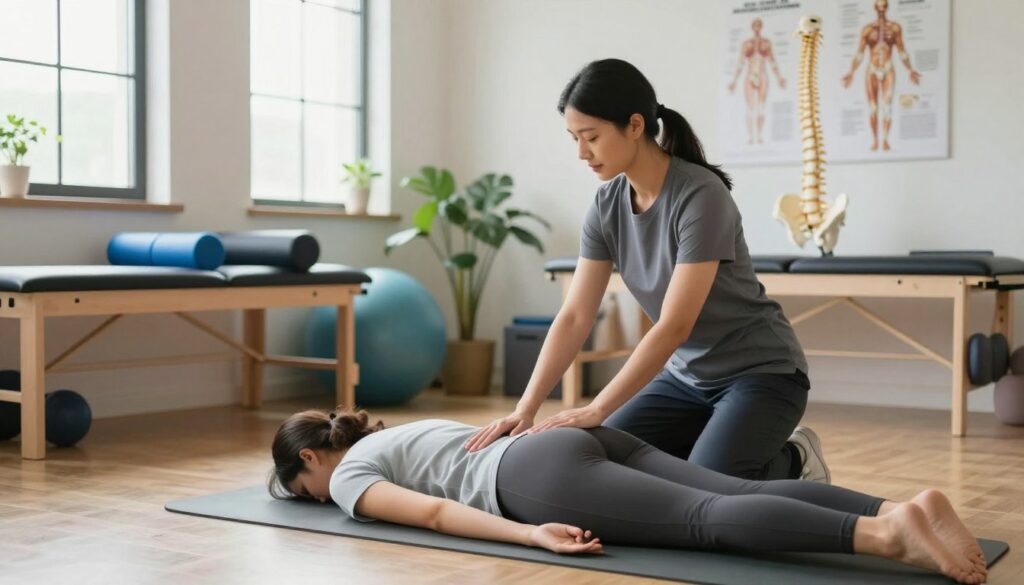
Most people reach for a stretch the moment they feel tightness. It makes intuitive sense — if something feels restricted, loosen it up. But that logic breaks down when you understand what back tension actually is.
Flexibility vs. Stability: They Are Not the Same Thing
Flexibility is your range of motion. Stability is your ability to control that range. You need both, but they serve completely different purposes — and most people with back pain are missing the second one.
When your spine lacks stability, your nervous system sends a signal to the surrounding muscles to tighten up. That tension isn’t a problem to stretch away. It’s a protective response — your body’s way of splinting an area it doesn’t trust.
When you force a stretch into that system, your brain often interprets it as a threat and tightens the muscles further. You get temporary relief at best. At worst, you reduce the very support your spine is relying on.
Why Over-Stretching Backfires
Think of the spine like a tent pole supported by guy-wires. If those wires are already loose, the last thing you want to do is loosen them further. You need tension — the right kind, in the right places.
Over-stretching an unstable segment doesn’t create freedom. It creates instability, which your nervous system then tries to compensate for by tensing everything back up. It’s a loop — and stretching harder won’t break it.
The Biomechanics of Back and SI Joint Pain
Your lower back doesn’t exist in isolation. It’s part of a system — and understanding that system is where real recovery begins.
The Lumbo-Pelvic-Hip Complex
Your lower back, pelvis, and hips operate as one integrated unit. Every time you walk, run, lift, or rotate, this complex has to distribute force efficiently across multiple joints. When one part is weak or immobile, the others compensate.
The most common pattern: stiff hips push extra rotational demand onto the lumbar spine. The lumbar spine is built for stability, not rotation. When it’s forced to rotate repeatedly under load, you get inflammation, compression, and pain.
How SI Joint Pain Develops
The sacroiliac joint is designed to be stable. It’s held in place by the muscles and connective tissue around it — which means when those stabilizers fail, the joint starts moving in ways it shouldn’t.
That instability tends to show up as pain during:
- Transitioning from sitting to standing
- Walking on uneven terrain
- Lifting while twisting
- Standing on one leg
Left unaddressed, the body creates compensatory patterns — overworking the lower back extensors, under activating the glutes, shifting gait mechanics — that layer problem on top of problem.
The Role of Compensatory Patterns
Compensation isn’t weakness It’s your body being resourceful , but resourceful isn’t the same as sustainable.
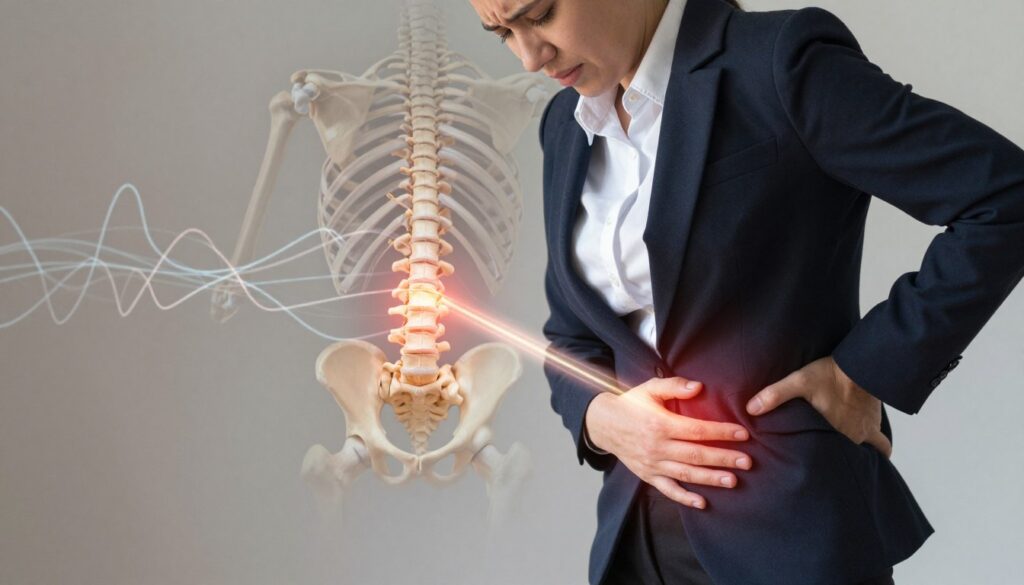
When deep stabilizers stop doing their job, larger, less precise muscles take over. You get tightness in the wrong places, weakness in the right ones, and a movement pattern that holds together — until it doesn’t.
Addressing the root cause means restoring the chain, not just treating the symptom.
Pilates for Back Pain: A Foundation for Functional Movement
This is where Pilates earns its place — not as gentle movement for people who can’t handle real training, but as a precision system for rebuilding how your body coordinates and controls itself.
Why Pilates Prioritizes Spinal Neutrality
Neutral spine isn’t a passive position. It’s an active skill. It’s the alignment where your vertebrae are stacked efficiently, your discs are under minimal shear, and your deep stabilizers can do their job.
Most people lose neutral the moment they add load or speed. Pilates trains you to hold it first in controlled positions, then in dynamic movement, then eventually under the actual demands of your sport or activity.
Moving Beyond Isolated Exercises
Standard physical therapy does important work but it often targets isolated muscles rather than movement patterns. You strengthen one thing in one direction, then return to the same compensatory habits the moment you stand up.
Pilates for back pain works differently. Every exercise is an integration problem. You’re not just firing a glute — you’re maintaining pelvic stability while a limb moves, breathing correctly, and keeping your ribcage from flaring. That’s the transfer that actually carries into your training and daily life.
Building Resilience Through Controlled Load
Controlled resistance teaches your stabilizers to hold position under stress. Low-impact doesn’t mean low-demand — it means the joints aren’t being compressed or sheared while the muscles are being challenged.
This is how you build a back that holds up under a heavy deadlift, a 10-mile run, or a full day at a desk.
Mastering Transverse Abdominis Activation
Before you can stabilize effectively, you need to find the right muscles. Most people have never consciously connected to their deep core — and that gap is often the root of the problem.
Anatomy of the Deep Core
The transverse abdominis (TA) is the deepest layer of your abdominals. It wraps around the trunk like a wide belt, from the spine to the front of the abdomen. Its job is to create intra-abdominal pressure — a rigid canister effect that supports the lumbar spine before movement even begins.
This is anticipatory stability. A healthy TA fires a fraction of a second before your limbs move. When this system is offline, your back is essentially moving without a seatbelt.
How to Activate Transverse Abdominis Correctly
Lie on your back with your knees bent. Place your fingertips just inside your hip bones. Inhale to prepare — then as you exhale, gently draw the lower abdomen inward, as if narrowing the space between your hip points.
You should feel a subtle, firm engagement under your fingertips. This is not a dramatic suck-in. It’s a quiet activation that doesn’t change your breath or tilt your pelvis.
That’s how to activate the transverse abdominis correctly. From here, every stabilization exercise becomes more effective.
Common Mistakes in Core Engagement
The three most common errors when people try to “engage their core”:
Bracing too hard. Gripping the outer abdominals creates tension but blocks the deep system from working. You want firmness, not rigidity.
Holding the breath. The TA works in coordination with the diaphragm. Hold your breath and you short-circuit the whole system.
Tucking the pelvis. Flattening the lower back removes the neutral position you’re trying to stabilize. Keep the natural curve.
The Critical Link Between Hip Internal Rotation and Back Health
Here’s something most back pain programs miss entirely: the spine and hips share rotational responsibility. When the hips can’t rotate properly, the lumbar spine picks up the slack and that’s where the breakdown happens.
Why Limited Hip Mobility Forces the Lower Back to Work
Your hips are built for mobility. Your lower back is built for stability. That’s the design. But when the hips are stiff or poorly coordinated, every rotation — every step, every swing, every twist — gets borrowed from the lumbar spine instead.
Over time, that repetitive micromotion degrades the discs, irritates the facet joints, and creates the kind of chronic low-level inflammation that never fully resolves.
Pilates for Hip Internal Rotation
Pilates addresses this through targeted hip dissociation work with exercises that train the hip to move independently within the socket, without dragging the pelvis or lumbar spine along for the ride.
Internal hip rotation isn’t about aggressive stretching with pilates; it’s about teaching your neuromuscular system to access and control that range—slowly, deliberately, and precisely.
Restoring Pelvic Alignment Through Hip Mechanics
When the hips are moving well, the pelvis finds neutral more easily. When the pelvis is neutral, the lumbar spine stops compensating. The whole system settles.
This is the hip-spine connection at the center of everything in this practice. Fix the hips, and the back often follows.
Deep Core Exercises for Spinal Stability
Knowledge doesn’t move you. Practice does. Here’s how to build the foundation.
The Pelvic Tilt and Its Role in Core Integration
The pelvic tilt is where most people should start — not because it’s easy, but because it teaches you to find neutral and feel the difference between positions. It’s the baseline skill everything else is built on.
Rock gently forward and back, then find the midpoint. That’s your neutral. Practice returning to it after every exercise, every set, every rep.
Progressing from Static Holds to Dynamic Movement
Once you can hold stability in a static position, add movement. A heel slide. A leg lift. A single arm reach. These are deep core exercises for spinal stability because they force your torso to stay still while your limbs move — exactly what happens when you run, rotate, or lift.
This is the progression point where most people get impatient and skip ahead. Don’t. The dynamic work only transfers when the static foundation is solid.
Integrating Breathwork for Intra-Abdominal Pressure
Breath and stability are not separate skills. The exhale drives the TA. The inhale must expand into the sides and back of the ribcage, not just the chest.
Inhale: ribs expand three-dimensionally. Exhale: gentle draw of the lower abdomen, ribcage stays soft, spine stays neutral. Repeat. Build this into every exercise until it becomes automatic.
Core Stability Exercises for SI Joint Pain
SI joint dysfunction responds well to specific loading — once you know what you’re working with.
Stabilizing the Pelvis During Leg Movements
The key test: can you move your leg without your pelvis moving? Most people can’t, at first.
Practice supine heel slides or bent-knee fallouts with one hand on each hip point. If one side rises or tips, you’ve found where your stability breaks down. Core stability exercises for SI joint pain are built around this — training the pelvis to stay level while the legs do the work.
Addressing Asymmetry in the SI Joint
SI dysfunction is almost always asymmetrical. One side does more. One hip rotates less. The body compensates. Unilateral work exposes this quickly.
Work each side deliberately. Go slower on the weaker side. Build endurance in the stabilizers before adding complexity.
Building Endurance in the Stabilizing Muscles
Power isn’t the problem here. Endurance is. Your stabilizers need to hold position not for two seconds, but for two hours — through a run, a workday, a training session.
Longer holds, lower intensity. That’s the prescription for building the kind of deep support that changes how your back feels in real life.
Creating Your Daily Stability Routine
You don’t need an hour. You need consistency.
Structuring a Consistent Practice
Anchor your stability work to something already fixed in your day. Morning before coffee. Post-run cooldown. Ten minutes before bed. Choose three or four foundational movements, do them well, and do them daily.
Quality over quantity. Precision over speed. This is how neurological change happens — through repetition, not intensity.
Monitoring Progress and Pain Levels
Track how your back feels before and after each session. Note what flares it and what settles it. Pain that gradually decreases over weeks means you’re on the right track. Sharp, shooting, or radiating pain is a signal to stop and reassess.
This kind of body awareness is a skill — and it’s one of the most valuable things you’ll develop through this work.
When to Seek Professional Guidance
If symptoms are not improving after consistent effort, or if you experience numbness, tingling, or pain radiating into the leg, see a specialist. A qualified movement professional can identify what a self-guided program can’t.
Asking for help accelerates progress. It doesn’t undermine it.
Building a Future of Pain-Free Movement
The goal here isn’t just a back that hurts less. It’s a body that holds up under the demands you place on it — training, sport, work, life — for years to come.
Stability is the foundation. Hip mechanics are the missing link. Deep core control is what bridges pain relief to performance. And all of it starts with learning to move with precision before you add intensity.
If you want a structured way to assess where your movement is breaking down, download the Back Pain Blueprint — a step-by-step checklist that walks you through the key patterns this post covers, so you know exactly where to start.
Because tightness is often a neurological protection response, not a flexibility deficit. When the spine feels unstable, the surrounding muscles contract to guard it. Stretching that tension away can reduce the support your body is relying on. Build stability first — the tightness typically resolves as your brain gets the message that the area is protected.
Lie on your back, fingertips just inside your hip bones. On your exhale, gently draw the lower abdomen inward — imagine narrowing the space between your hip points without tucking your pelvis or holding your breath. You should feel a subtle firmness under your fingers. That’s the activation. Everything else builds from there.
Your hips are designed for mobility; your lumbar spine is designed for stability. When hip mobility is limited, your lower back compensates by rotating more than it should. Pilates for hip internal rotation restores this balance by training the hip joint to move independently, so the lumbar spine can return to its job of staying stable.
Yes. The focus is on training the pelvis to stay level while one leg is moving — which is exactly what happens during running gait. Core stability exercises for SI joint pain like dead bugs, supine marching, and single-leg glute work train the deep stabilizers to manage asymmetrical load. Progress these before returning to full mileage.
Physical therapy often isolates individual muscles for rehabilitation. Pilates for back pain works with integrated movement patterns — stabilizing the spine while the limbs move, coordinating breath with engagement, building strength that transfers to real activity. The goal isn’t to fix one muscle; it’s to rebuild how your whole system moves.
Sit-ups create spinal flexion under load and heavily recruit the hip flexors. Deep core exercises for spinal stability work with intra-abdominal pressure, breath, and neutral spine — which is how your core actually needs to function during running, lifting, and daily movement. One trains a shape; the other trains a system.
Most people notice a shift in body awareness and pain levels within two to four weeks of consistent, intentional practice. Structural change takes longer. The timeline depends on how long the pattern has been in place and how consistently you train. Progress compounds — small daily practice outperforms occasional intense sessions every time.
Stay Connected and Enhance Your Wellbeing
- Website: https://www.clarissabooker.com
- Explore More Free Resources: Wellness Resources
- Contact Us: info@clarissabooker.com
- YouTube: Clarissa Booker
Please stay connected with us for tools, resources, and support on your holistic wellness journey!